Best Screen Printing Kits for Beginners (2026)
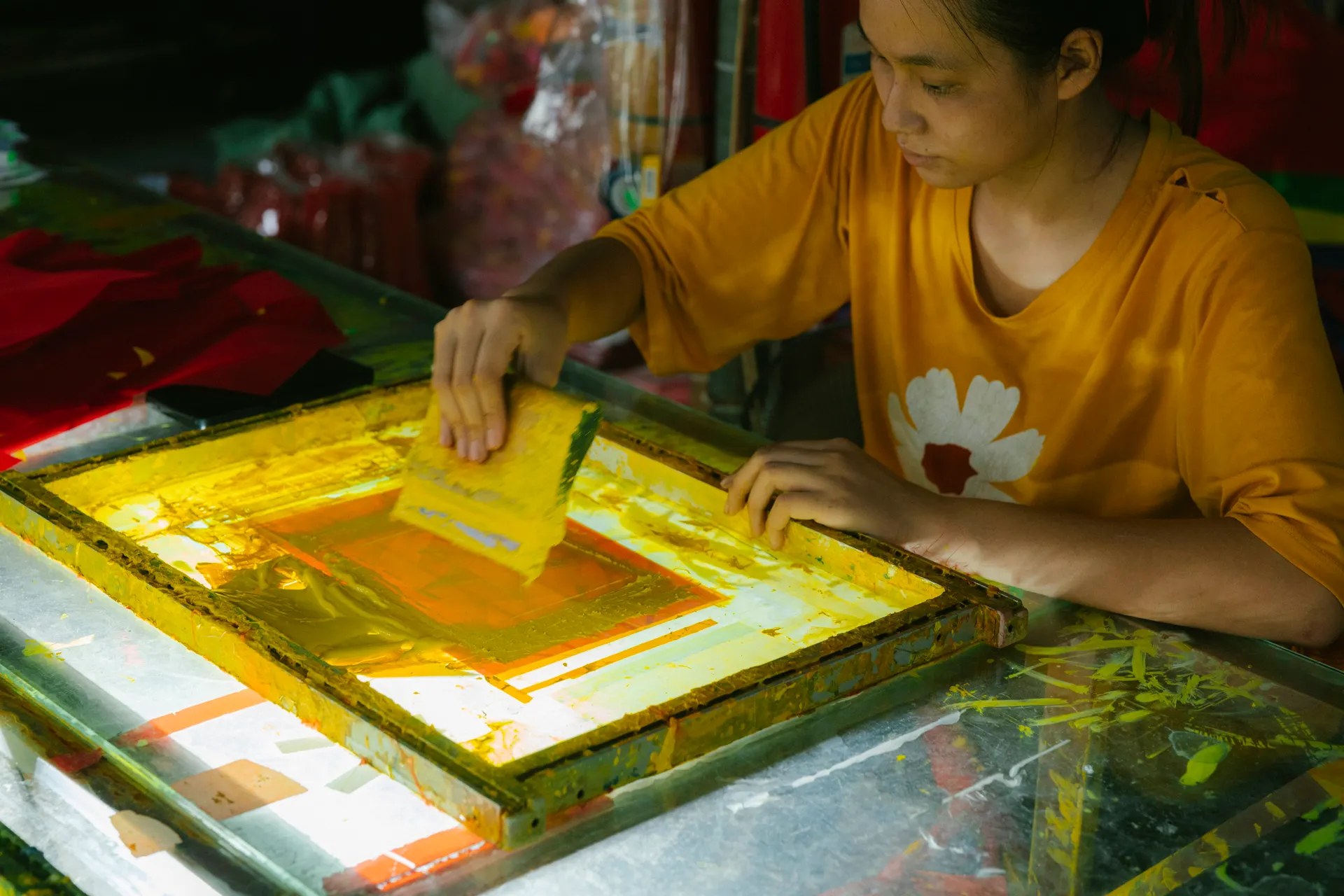
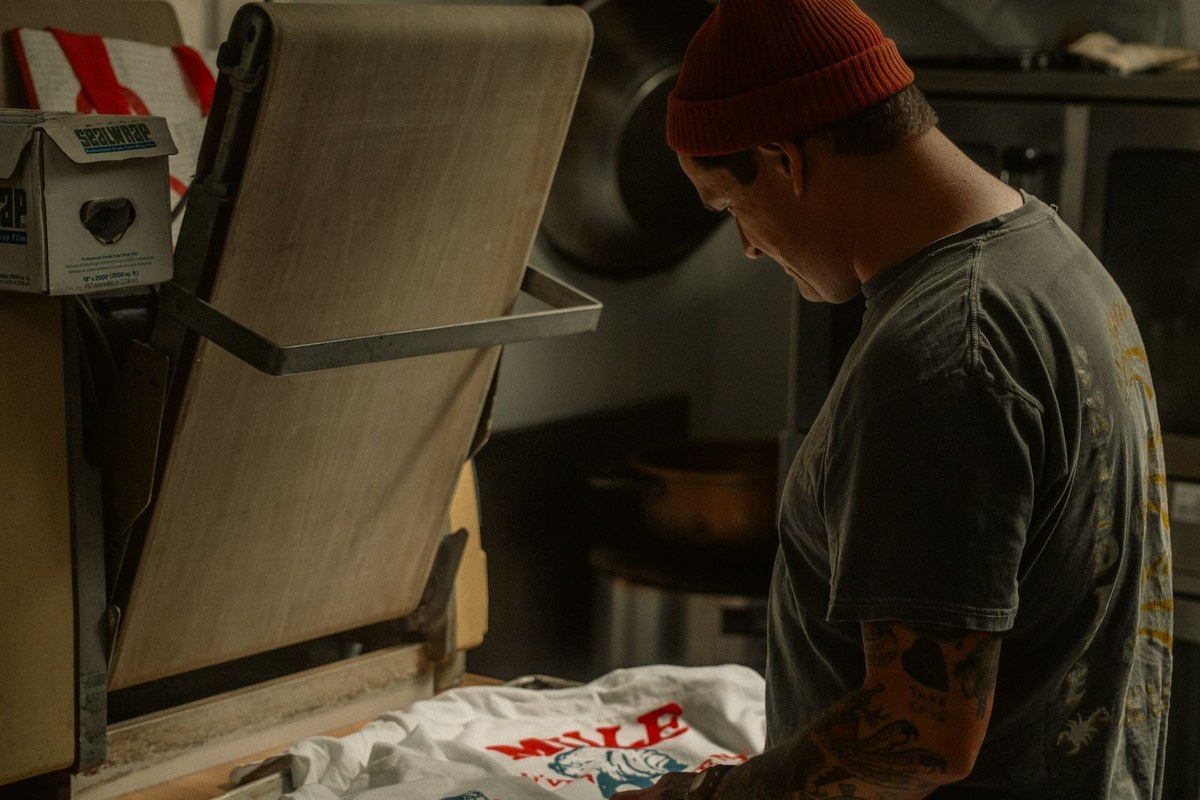
Screen printing is the seller's print method: make one good screen and the same design prints on ten shirts or a hundred, with the cost per shirt falling every time you pull the squeegee. That is why it beats one-off methods for a design that sells more than a handful of times. The beginner kits, though, are not one product category — they are three different crafts in similar boxes. Some kits make the stencil with drawing fluid and screen filler, painted on by hand. Some use craft vinyl cut on a Cricut or Silhouette. And some use photo emulsion, where a design printed on a transparency is exposed onto the screen with a lamp — the method real print shops use, and the only one that holds fine detail.
So the first question is not "which kit is best?" but "which method do I want to learn, and what is actually in the box?" The trap in this category is the piece count: a "54-piece kit" can mean three frames and a lamp, or one frame and forty mixing sticks. The honest count is four things — frames, ink, emulsion, and an exposure lamp. The six picks below are ordered by how a beginner actually progresses: a cheap frames-first kit, the classic method teacher, the vinyl shortcut, two ways to get an exposure lamp in the box, and the press you graduate to.
The short answer
- Best overall: Caydo 23 Pieces Screen Printing Starter Kit ($33.99) — three wood frames (10x14, 8x12, and 6x10 inches), two squeegees, transparency film, ink knife, and tape. Frames and tools only — ink is a separate buy. Check price on Amazon →
- Best for learning the craft: Speedball Intermediate Screen Printing Kit — one 10x14 frame, black and red fabric inks, and everything for both the drawing fluid and photo emulsion methods. Check price on Amazon →
- Best for cutting-machine owners: Speedball Deluxe Screen Printing Craft Vinyl Kit — two 10x14 frames, four fabric inks, and vinyl stencil sheets, with no emulsion or chemicals at all. Check price on Amazon →
- Best brand-name photo emulsion kit: Speedball Advanced All-In-One Screen Printing Kit — a 10x14 frame on a base, four fabric inks, Diazo emulsion, and the exposure lamp included. Check price on Amazon →
- Best complete bundle: Pllieay 60pcs Screen Printing Kit ($129.99) — three frame sizes, six inks, emulsion, and a 25W LED UV exposure lamp in one box. Check price on Amazon →
- Best step-up press: VEVOR Screen Printing Machine, 4 Color 1 Station — a rotating steel press with a 21.2x17.7 inch pallet for multi-color work. A press only: screens and ink are separate. Check price on Amazon →
Caydo 23 Pieces Screen Printing Starter Kit — the best first buy
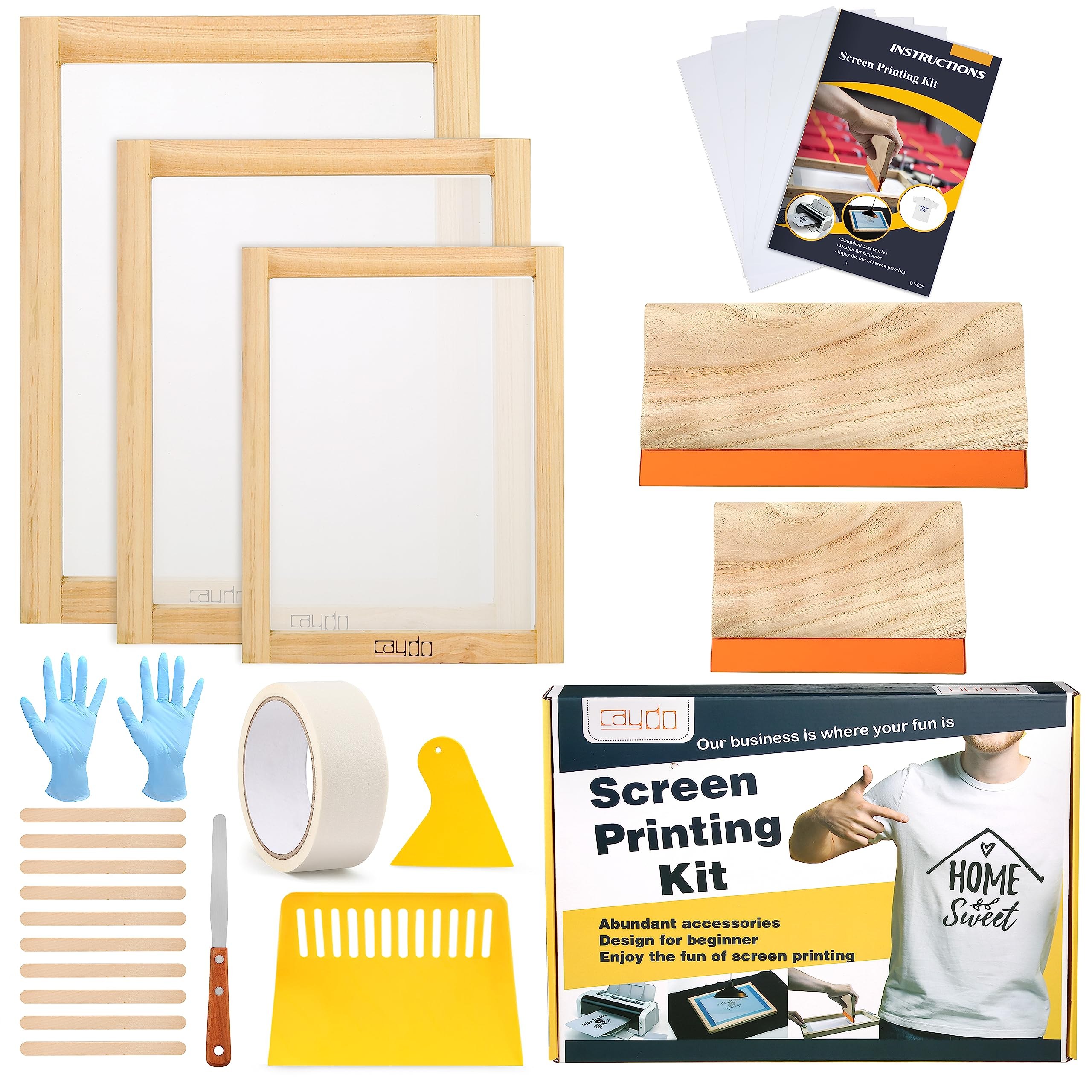
Most beginners do not need a system — they need screens. The Caydo 23-piece kit is three wooden frames with mesh in the three sizes you will actually use (10x14 inches for a chest print, 8x12 for smaller designs, 6x10 for sleeves, totes, and logos), two wooden squeegees, inkjet transparency film, an ink knife, masking tape, gloves, and stir sticks. Three frames matter more than they sound: a screen tied up with one design is a screen you cannot use for another, and sellers quickly end up wanting one screen per design. At $33.99 this is the cheapest honest way onto a real frame-and-squeegee setup. The catch is in the name — it is a starter kit for the printing side only. There is no ink and no emulsion in the box, so budget for a fabric ink and either emulsion or screen filler alongside it, or your first session ends at unboxing.
Honest pros:
- Three frame sizes in one box — one screen per design, no re-coating between jobs
- Two squeegees, transparency film, ink knife, and tape — the working tools are all here
- $33.99 — the lowest-cost route to real frames instead of a toy kit
- Frames are reusable for years — reclaim the mesh and coat a new design
Honest cons:
- No ink and no emulsion included — the true first-session cost is the kit plus supplies
- No exposure lamp — photo emulsion work means sunlight or a separate lamp
- Wood frames can warp if left soaking — dry them flat after washing
Speedball Intermediate Screen Printing Kit — the method teacher
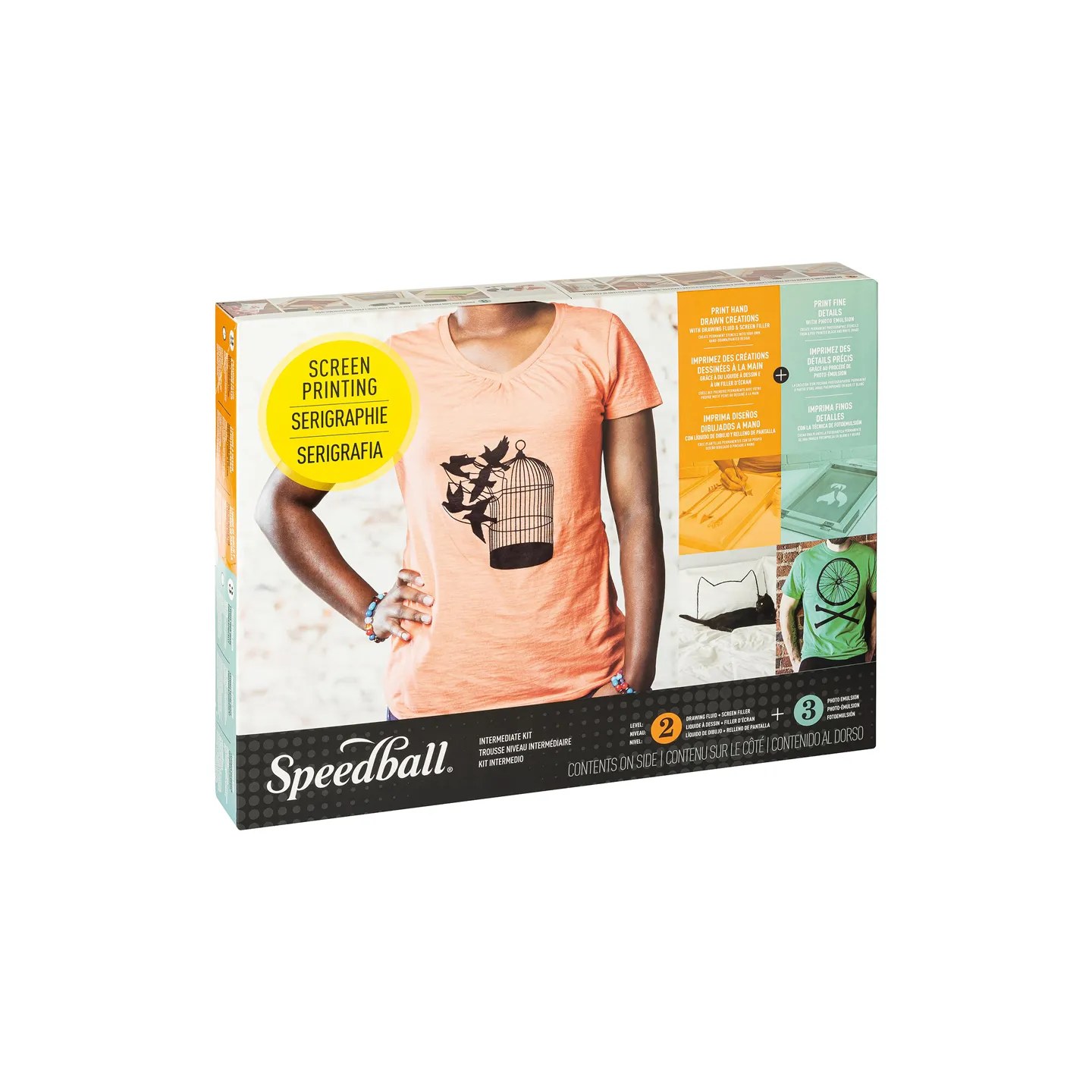
Speedball has taught screen printing to beginners for decades, and this kit is why: it contains both traditional stencil methods in one box, so you learn the craft instead of one shortcut. You get a 10x14 inch screen, a Red Baron squeegee, two 4 oz fabric inks (black and red), drawing fluid and screen filler for hand-painted designs, plus Diazo photo emulsion, sensitizer, emulsion remover, and Speed Clean for photographic designs — with a brush, craft sticks, and the instruction booklet that walks through both. Drawing fluid is the forgiving place to start: paint your design, coat with filler, rinse the fluid out, print. Photo emulsion is where you graduate for crisp, detailed, repeatable work. No lamp is included, so emulsion exposure is a sunlight-and-timing exercise at first — workable, and it teaches you what exposure does before you pay for a lamp.
Honest pros:
- Both stencil methods included — drawing fluid for hand-drawn work, emulsion for detail
- Ink, emulsion, remover, and cleaner all in the box — a complete first session
- Speedball's instructions are the clearest in the category
- Made in USA, and every supply is sold separately for restocking
Honest cons:
- One frame only — a second design means reclaiming the first
- No exposure lamp — emulsion work depends on sunlight or a separate light
- Only two ink colours — a working palette is a follow-up purchase
Speedball Deluxe Screen Printing Craft Vinyl Kit — the cutting-machine shortcut
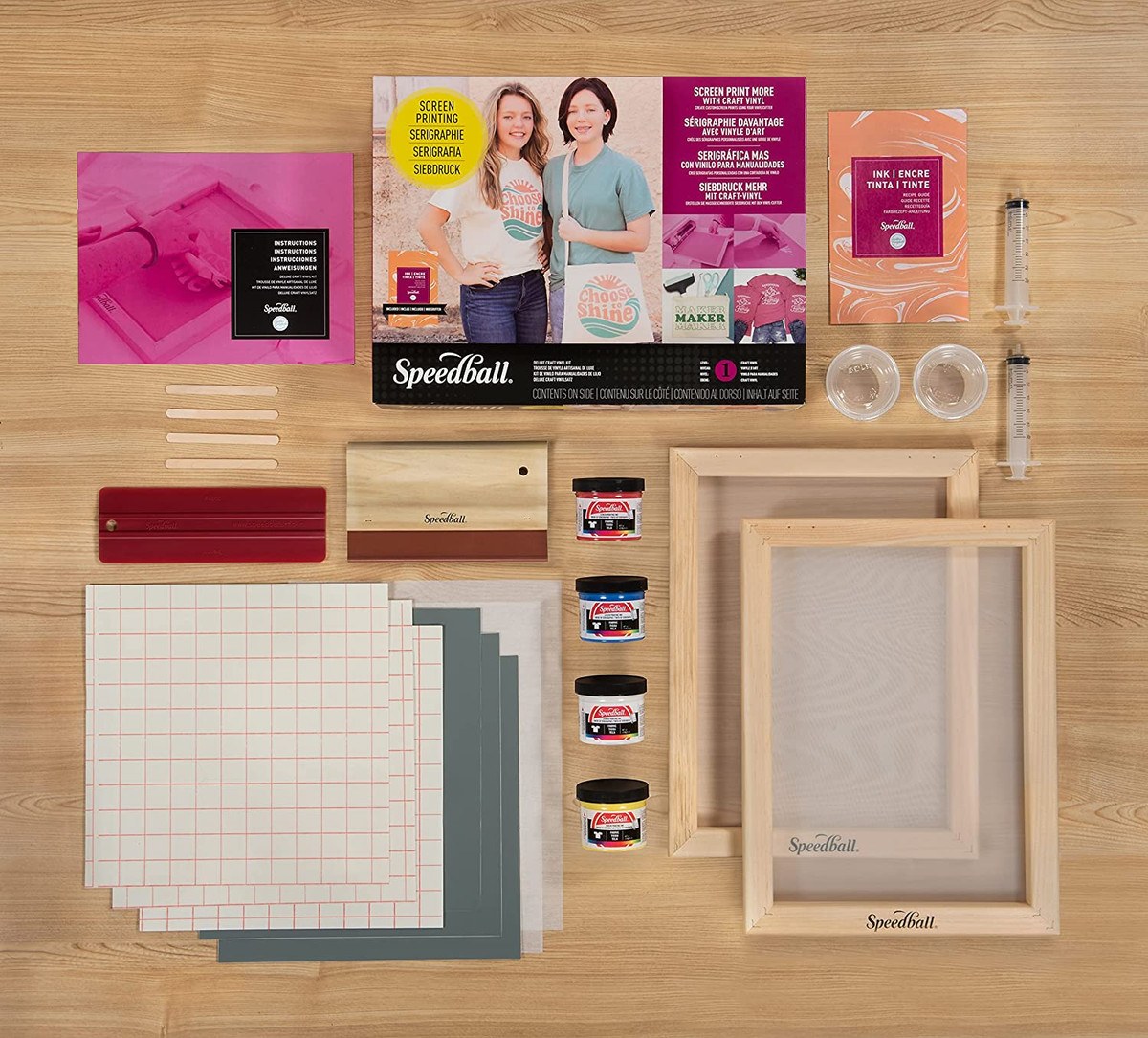
If you already own a Cricut or Silhouette — and many Etsy sellers do — this kit skips the chemistry entirely. Cut your design from craft vinyl, stick it to the underside of the screen, and print: the vinyl is the stencil. This Deluxe version is the one to buy over the smaller Beginner vinyl kit, because it doubles the useful parts: two 10x14 inch frames instead of one, four 4 oz fabric inks (white, yellow, blue, red) instead of black only, a Red Baron squeegee plus an 8-inch textile squeegee, three vinyl sheets, three transfer sheets, syringes and cups for ink mixing, parchment paper, and a mixing guide. Vinyl stencils are the fastest route from idea to first shirt, and the vinyl peels off so the screen is ready for the next design in minutes. The limits are real: fine detail and tiny text weed badly in vinyl, a stencil survives a short run rather than a production run, and you need the cutting machine — it is not included.
Honest pros:
- No emulsion, no exposure, no chemicals — printing within the hour
- Two frames and four ink colours — the Deluxe box fixes the Beginner kit's thin contents
- Vinyl removes cleanly — one screen serves many designs
- Built for the Cricut and Silhouette machines sellers already own
Honest cons:
- Requires a cutting machine, which is not included
- Fine detail, small text, and long runs are beyond a vinyl stencil
- Only three vinyl sheets to start — restocks are a running cost
Speedball Advanced All-In-One Screen Printing Kit — photo emulsion, lamp included
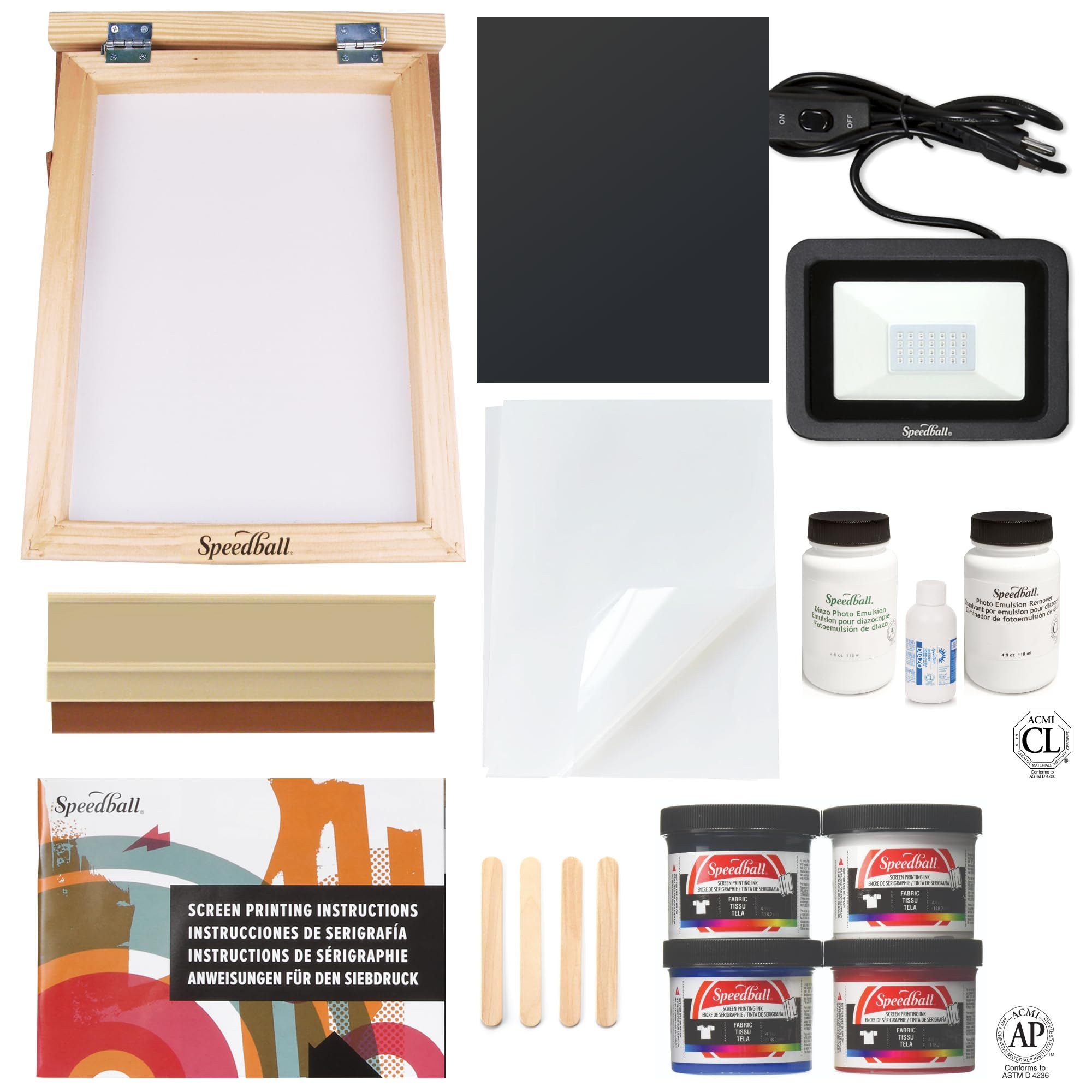
The Advanced kit is the Intermediate kit's graduation: it commits to the photo emulsion method and includes the one tool that makes it reliable indoors — an exposure lamp. The box holds a 10x14 inch wooden frame mounted on a base, a textile squeegee, four 4 oz fabric inks (black, red, white, blue), a 3.3 oz bottle of Diazo photo emulsion with sensitizer, photo emulsion remover, two transparencies, the lamp with clamp, craft sticks, and a sheet of black paper for exposure. The lamp is the point. Emulsion exposed under a consistent lamp at a consistent distance gives the same result every time; emulsion exposed in sunlight is a guess that changes with the weather, and a ruined screen costs more emulsion and an hour. If you know your designs will come from a computer — logos, lettering, line art — this is the Speedball to buy, and the Intermediate's drawing-fluid method is the step to skip.
Honest pros:
- Exposure lamp included — repeatable emulsion exposure indoors, day or night
- Four fabric inks and a frame on a base — a steadier setup than a loose frame
- Full emulsion set with remover — coat, expose, print, and reclaim with one brand's system
- Detailed, photographic designs that vinyl and drawing fluid cannot hold
Honest cons:
- One frame — multi-design sellers will add frames quickly
- Photo emulsion has a learning curve: coating thickness and exposure time take test prints
- No drawing fluid or screen filler — hand-painted designs are not this kit's method
Pllieay 60pcs Screen Printing Kit — the complete bundle
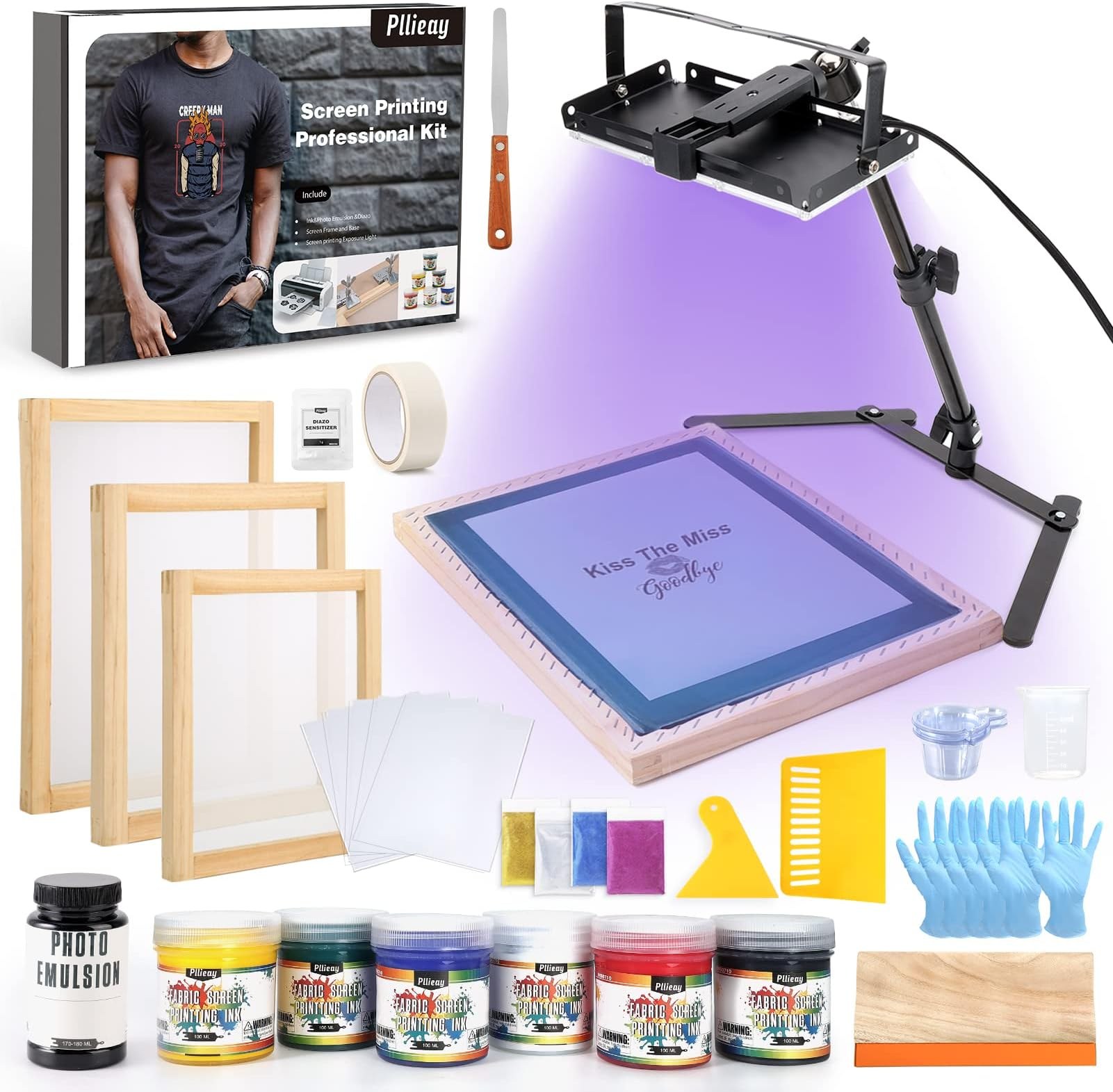
Pllieay's 60-piece kit is the bundle play: everything the Caydo frames kit lacks, added to the same three-frame foundation. You get three wood frames (10x14, 8x12, and 6x10 inches), six colours of screen printing ink, photo emulsion with Diazo sensitizer, five A4 inkjet transparency films, and a 25W LED UV exposure lamp on a stand — plus the working extras: squeegee, scrapers, measuring cups, gloves, and mixing sticks. At $129.99 it costs roughly what the Caydo kit plus ink, emulsion, and a lamp bought separately would come to, and it arrives as one matched set. The honest discount is in the details: the 60-piece count includes cups, sticks, and gloves, the lamp is a small 25W unit that wants careful positioning over the larger frame, and the instructions are thinner than Speedball's. Judge it by the core list — three frames, six inks, emulsion, lamp — which is genuinely complete.
Honest pros:
- Frames, six inks, emulsion, and an exposure lamp — nothing else to buy for a first print
- Three frame sizes, so designs and screens can rotate like the Caydo set
- LED lamp on a stand — hands-free exposure without a darkroom
- $129.99 all-in compares well with buying the same core pieces separately
Honest cons:
- The 60-piece headline counts sticks, cups, and gloves — the core kit is what matters
- 25W lamp is the minimum for the 10x14 frame — exposure takes positioning and patience
- Instructions are brief — expect to lean on general screen printing guides
VEVOR Screen Printing Machine, 4 Color 1 Station — the step-up press
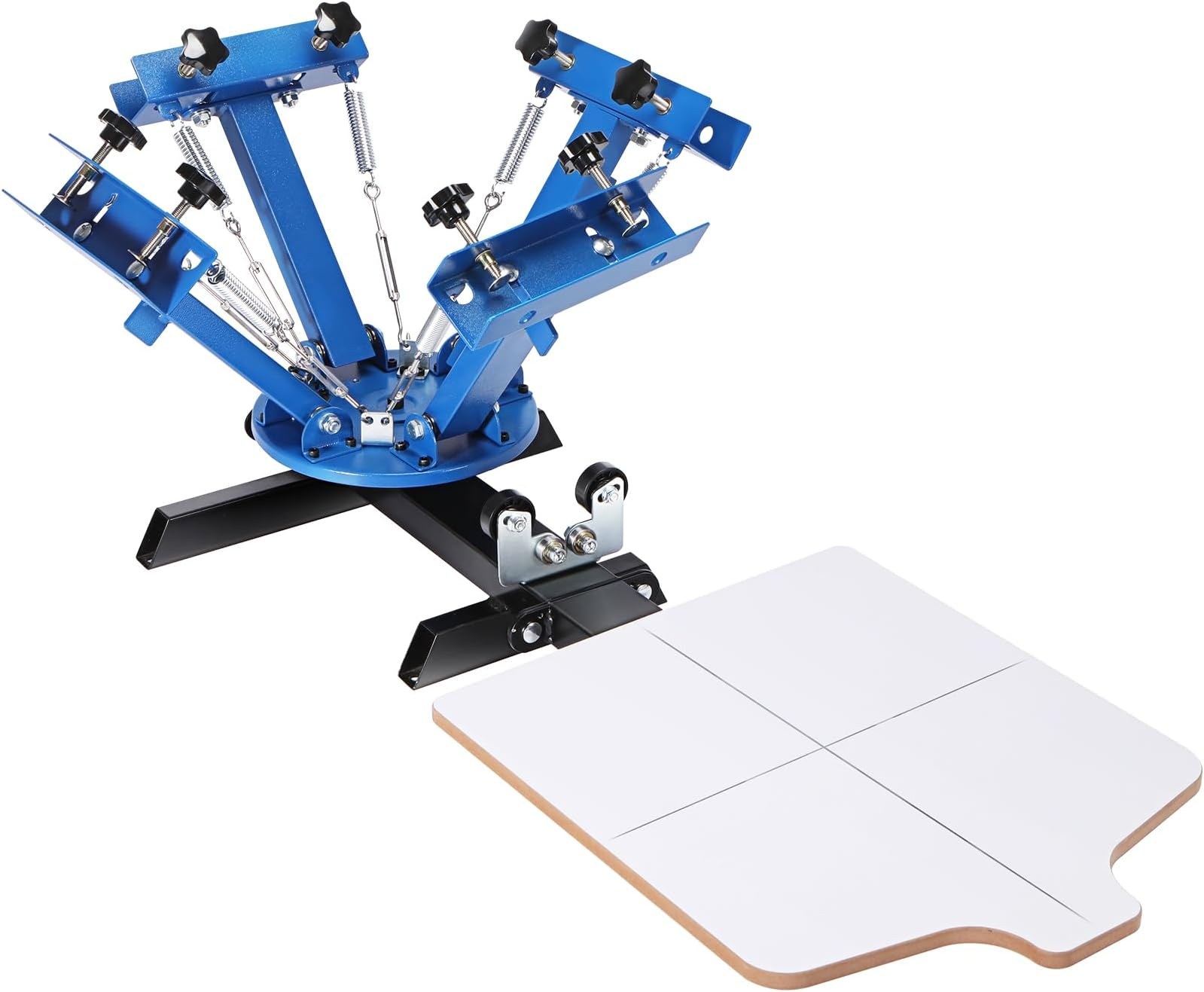
This last pick is not a kit, and that is exactly why it is here: it is what the kits lead to. A hand-held frame prints one colour, in slightly different positions, at hand speed. The VEVOR press holds the shirt on a 21.2x17.7 inch double-layer positioning pallet while four screen arms rotate 360 degrees over it, so a four-colour design lands in the same place on every shirt — registration is the whole product. The body is cold-rolled steel at about 41 lbs, with adjustable tension, and it bolts down to a bench. What is in the box is the machine, wrenches, and a manual: no screens, no ink, no emulsion, no squeegee. Buy it when a design is selling in multi-colour and your arms, not your ideas, are the bottleneck — and budget for the frames and supplies from the kits above to feed it.
Honest pros:
- Four-colour registration — layered designs line up shirt after shirt
- Steel build and a double-layer pallet — stable, repeatable positioning
- 360-degree rotating arms keep a one-person workflow moving
- The cheapest credible route from hand printing to press printing
Honest cons:
- Press only — screens, ink, emulsion, and squeegees are all separate purchases
- Assembly required, and it needs a bench it can bolt to
- One station — the shirt is loaded and unloaded at the same spot, so it is not a production line
Side-by-side
| Caydo 23 pcs | Speedball Intermediate | Speedball Deluxe Vinyl | Speedball Advanced | Pllieay 60 pcs | VEVOR 4 Color Press | |
|---|---|---|---|---|---|---|
| Typical price | $33.99 | Check latest price | Check latest price | Check latest price | $129.99 | Check latest price |
| Stencil method | Yours to add | Drawing fluid + photo emulsion | Craft vinyl | Photo emulsion | Photo emulsion | Works with your screens |
| Frames | 3 (10x14, 8x12, 6x10 in) | 1 (10x14 in) | 2 (10x14 in) | 1 (10x14 in, on base) | 3 (10x14, 8x12, 6x10 in) | None — press only |
| Ink included | No | 2 fabric inks | 4 fabric inks | 4 fabric inks | 6 inks | No |
| Exposure lamp | No | No | Not needed | Yes | Yes, 25W LED | No |
| Best for | First frames on a budget | Learning the craft | Cricut & Silhouette owners | Detailed designs, brand system | One-box complete start | Multi-colour step up |
How to choose
Pick the method before the kit. Hand-drawn, painterly designs: drawing fluid (Speedball Intermediate). Designs already living in your cutting machine's software: vinyl (Speedball Deluxe Vinyl). Logos, lettering, and anything with fine lines: photo emulsion (Speedball Advanced or Pllieay). Every other difference between these boxes is secondary to that one choice, and switching methods later means buying the supplies again.
Count four things, not the headline number. Frames, ink, emulsion, lamp. A kit missing ink (Caydo) is a frames purchase — a good one, priced like one. A kit missing a lamp (Speedball Intermediate) is a sunlight kit until you add one. The Pllieay is the only bundle here with all four, which is the entire reason it costs what it does.
One screen per design is the seller's rule. Reclaiming a screen erases the design. If you sell three designs, you want at least three frames, which is why the three-frame Caydo and Pllieay sets suit sellers better than single-frame kits — or why single-frame buyers should budget for extra frames from the start. Frames are cheap; re-coating a screen for every order is not a workflow.
The press comes last, on purpose. A press fixes registration and speed, nothing else — it does not improve a bad screen or a thin design. Print by hand until a multi-colour design is selling steadily, then let the VEVOR earn its bench space. And whichever route you start with, the shirts themselves decide your margins: our blank t-shirts guide covers the tees that take ink well, our heat press guide covers the curing and HTV side of the bench, and our HTV guide covers the one-off alternative for designs that sell one at a time.
FAQ
Do I need an exposure lamp to screen print?
Only for the photo emulsion method — and there, a lamp is what makes exposure repeatable indoors. Drawing fluid and vinyl stencils need no light at all. Emulsion can be exposed in strong sunlight, but times vary with the weather, which is why both lamp kits in this guide exist.
What else do I need besides the kit?
Shirts or blanks to print on, a flat surface the screen can clamp or rest on, and a way to wash screens out — a sink or hose with some pressure. Fabric ink also needs heat setting to survive washing, following the ink's own instructions; a heat press or a household iron does that job.
Screen printing or HTV — which is better for a seller?
They split on volume. HTV wins for one-off personalised shirts: no screens, no setup, a different name on every shirt. Screen printing wins the moment one design sells repeatedly: the screen is made once, and each extra shirt costs ink and minutes. Most apparel sellers end up with both, and start with the one that matches their first product.
How long does a screen last?
The frame and mesh last for years. A single emulsion stencil lasts for a long run of prints if it is handled gently and stored flat, and when the design is done you strip the emulsion with remover and coat the same screen again. Vinyl stencils are the short-lived exception — plan on them for short runs.
Can I print on things other than t-shirts?
Yes — tote bags, hoodies, posters, and cards are the usual next surfaces, and the smaller 6x10 and 8x12 frames in the Caydo and Pllieay sets exist for exactly those. Fabric needs fabric ink; paper work is more forgiving. Keep the surface flat and taped down, and the same screen technique applies.